This guide compares Buffalo city neighborhoods with nearby Western New York suburbs that relocating buyers often consider, including Amherst, Clarence, Orchard Park, and East Aurora. We've pulled safety references from current, publicly available sources wherever possible. Still, conditions can shift from one street or block to the next, so treat this list as a starting point for your own research, not a guarantee.
Key Takeaways
- Compare safety data with housing costs, commute times, schools, and walkability before narrowing your search
- Amherst, Clarence, Orchard Park, and East Aurora for suburban space; North Buffalo, Elmwood Village, and Parkside for city character
- Downtown Buffalo fits buyers who want entertainment and convenience over a quiet residential setting
- A local agent can compare exact blocks, current listings, and property condition before you offer
Overview of Buffalo's Safest and Best Neighborhoods
"Safest" means different things to different buyers. It can refer to:
- Reported crime
- Traffic and pedestrian conditions
- Emergency response
- How well a street is maintained
- How residents feel walking out their front door
No single ranking captures all of that, and Buffalo's own incident map is explicitly preliminary.
The city notes that information before January 2009 is unreliable and that its dataset doesn't capture every call police respond to, according to Buffalo's open data. That's worth remembering any time you see a neighborhood labeled "safest" without a source attached.
Buffalo's housing stock reflects its age and layout:
- Historic city homes - early 1900s architecture, often with original woodwork and smaller lots
- Duplexes and multifamily properties - common in city neighborhoods, popular with both owner-occupants and investors
- Condos and apartments - concentrated downtown and in redeveloped mill or warehouse buildings
- Suburban single-family homes - ranches, colonials, and new construction across Amherst, Clarence, Orchard Park, and East Aurora
City neighborhoods and surrounding towns aren't interchangeable, either. Amherst, Clarence, Orchard Park, and East Aurora are separate municipalities with their own police departments, school districts, and reporting boundaries.
A countywide sheriff statistic or a town-level police report doesn't automatically describe conditions inside a specific subdivision, so match any claim to the actual geography it covers before you rely on it.

Best and Safest Neighborhoods in Buffalo, NY
This shortlist weighs current safety information alongside residential character, schools, amenities, housing availability, and buyer demand. Where crime data exists, we've noted the source and its limits rather than presenting a single number as the full picture.
Amherst and Williamsville
Amherst draws buyers who want suburban services without giving up easy access to Buffalo. The town blends preserved historic homes with newer developments, and inventory ranges from starter homes to larger family residences and estates.
On safety: Amherst Town Police published a 2024 crime summary reviewed in late 2025, but that report covers the entire town police agency, not the Village of Williamsville specifically. Treat any town-level figure as a town-level figure, not proof about one subdivision.
Schools and housing context:
- Williamsville CSD's four-year graduation rate was 92% as of August 2025
- Amherst CSD's rate was 91% over the same period
- Williamsville village's median owner-occupied home value sat at $278,900 (2020-2024 Census figures), compared to $311,600 for Amherst town overall
This area tends to suit families, move-up buyers, and relocating professionals who want shopping, dining, and a short commute into the city without fully urban density.
Clarence
Clarence appeals to buyers who want more land and a quieter, less densely built setting while still commuting into the broader Buffalo job market. The town's own comprehensive plan describes a mix of estate lots, smaller patio homes, and attached residences, so "Clarence" doesn't mean one uniform lot size.
Policing here runs through the Erie County Sheriff and New York State Police Troop A, Zone 2, rather than a dedicated town police force. That means any crime figure attributed to "Clarence" is really a countywide sheriff statistic unless it specifically isolates the town.
A few practical notes for buyers:
- Clarence town's median owner-occupied home value was $408,500 for 2020-2024, per Census Bureau data
- Clarence CSD posted a 95% graduation rate as of August 2025
- Rural and semi-rural roads mean more driving dependence and longer response times during heavy snow
Expect to trade walkability for space. Clarence works best for move-up households that value a bigger yard over sidewalks and corner shops.
Orchard Park
Orchard Park is a long-time favorite for families chasing strong schools, parks, and a recognizable village center. Orchard Park CSD reported a 95% graduation rate for the 2024-2025 year, matching Clarence's figure.
A caution worth flagging: Highmark Stadium, home to the Buffalo Bills, sits in Orchard Park, but a sports venue says nothing about neighborhood crime or pedestrian safety. Don't let name recognition substitute for actual data. The town's most detailed police operations report dates to 2011, so current, verified town-level crime figures are harder to pin down than you'd expect for a town this well known.
Housing-wise, Orchard Park town's median owner-occupied value was $360,700 for 2020-2024. Several pockets near the village center deserve a closer look:
- The College Street Area, near shops, restaurants, parks, and schools
- The Buffalo Street (US-20A) Corridor, mixing classic village homes with mid-century and updated properties on tree-lined, sidewalk-lined streets
- The Pine Avenue Area, a traditional residential pocket close to the village center
Winter travel and property taxes both deserve attention here, as does confirming which elementary zone a specific address falls into before you commit.
East Aurora
East Aurora offers something harder to find elsewhere in the region: a walkable village core with independent shops, paired with a strong local identity. The Roycroft Campus, a National Historic Landmark, anchors the area, and Knox Farm State Park adds green space nearby.
East Aurora/Town of Aurora Police serve both the incorporated village and the surrounding town, so no verified crime count currently splits the two cleanly. A Walk Score reading of 79 out of 100 for one spot near Main Street earns a "Very Walkable" label, but that score reflects a single location, not the entire village.
Quick housing snapshot:
- Village of East Aurora median owner-occupied value: $364,100
- Town of Aurora median: $364,800 (both 2020-2024 figures)
- East Aurora UFSD's graduation rate: 95% as of August 2025
Streets like South Grove Street, just steps from the Roycroft Campus, and the Parkdale/Knox Road area, near Knox Farm, give buyers a feel for the mix of village-style homes and larger-lot properties available. Trade-offs include thinner inventory and a longer commute into downtown Buffalo compared to inner-ring suburbs.

North Buffalo, Elmwood Village, and Parkside
These three city neighborhoods shouldn't be lumped together with "Buffalo" as if it's one uniform market. Each has its own rhythm.
| Neighborhood | Housing snapshot | Walkability note |
|---|---|---|
| North Buffalo | $369K median sale price (three months ending April 2026, Redfin) | City average Walk Score is 67/100, not neighborhood-specific |
| Elmwood Village | Mix of vintage and updated historic homes | 91/100 at Elmwood Ave & St James Pl (single point, not the whole area) |
| Parkside | $470K median sale price (February 2026, Redfin) | No verified full-neighborhood Walk Score available |
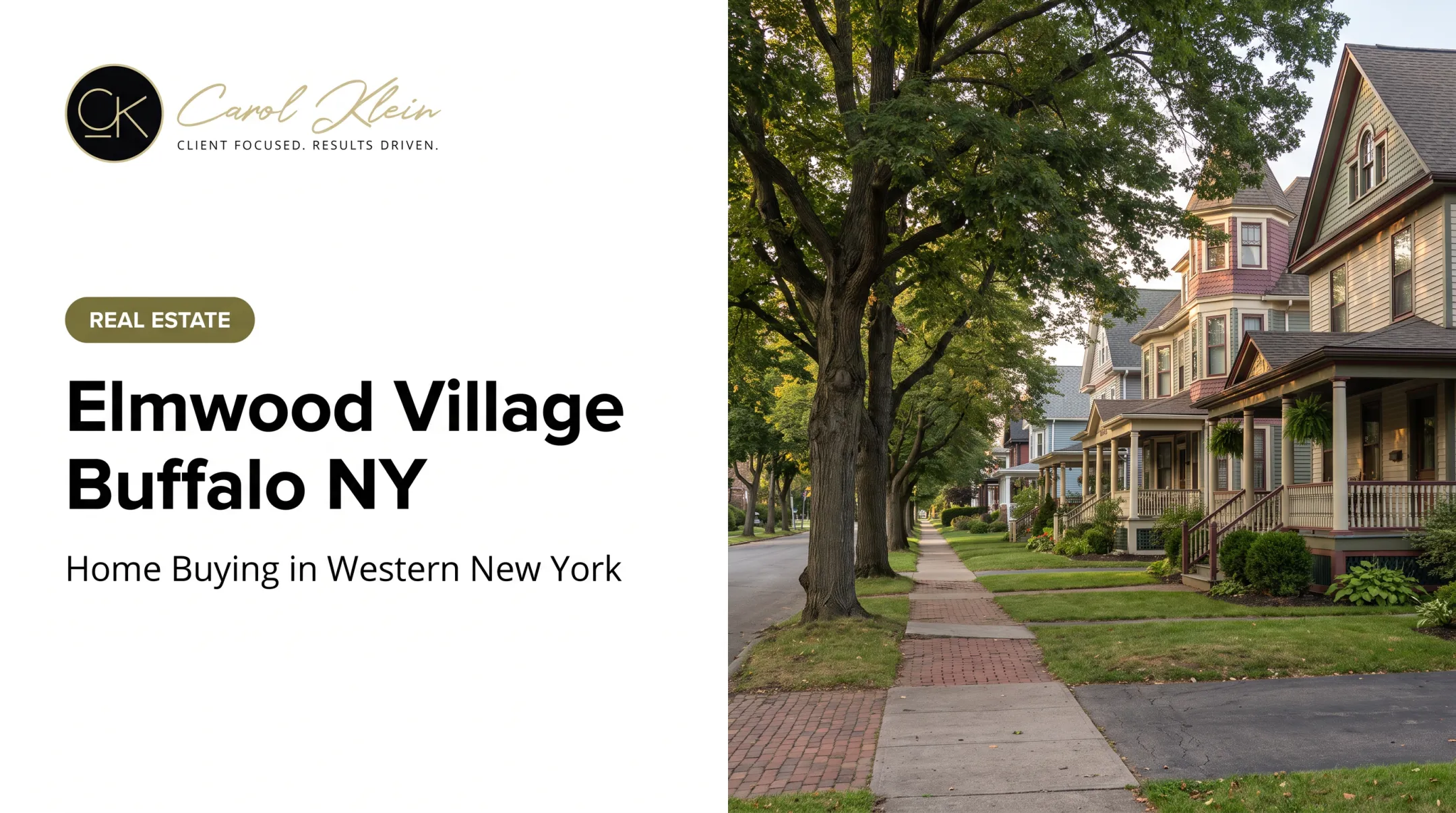
Elmwood Village has a genuinely lively commercial strip, with restaurants, boutiques, and NFTA's Route 20 bus connecting the corridor to downtown and Kenmore. Parkside, bordering Delaware Park, draws buyers who want historic architecture near green space. North Buffalo sits between the two in price and pace, with a more residential, less commercial feel on most blocks.
The trade-off across all three: older housing often means renovation needs, tighter parking, and more street noise than you'd find in the suburbs. Buffalo's incident map lets you check a specific block, but remember the data is preliminary and doesn't isolate neighborhood-level rates precisely. Walk or drive the exact street before you fall in love with a listing photo.
How We Chose the Best and Safest Buffalo-Area Neighborhoods
We weighed several factors together rather than ranking by crime numbers alone:
- Current safety data - sourced from police departments, state DCJS index-crime reports, and municipal publications, with publication dates noted
- Housing conditions - lot sizes, home age, and property type mix
- Schools and family fit - graduation rates from NYSED, matched to the correct district boundary
- Access and transportation - commute times, NFTA routes, and walkability scores tied to specific locations
- Overall buyer fit - budget, lifestyle, and priority match for each neighborhood
Getting honest rankings also meant avoiding common traps:
- Relying on outdated listicles instead of current sources
- Comparing a single city neighborhood against an entire suburban town
- Treating high property values as proof of safety
- Assuming a neighborhood is uniform from one street to the next
Before making an offer anywhere on this list, do your own legwork:
- Visit during both daytime and evening hours
- Walk or drive the exact block, not just the general area
- Check street lighting, traffic patterns, and sidewalk conditions
- Ask about flood history or environmental concerns if relevant
- Talk to a licensed professional about property-specific conditions, insurance costs, and resale potential
Safety is one input among several. Budget, taxes, maintenance costs, and your own daily routine matter just as much to whether a home actually works for you.

Conclusion
There's no single "best" Buffalo-area neighborhood. It depends on whether you want suburban space and top-rated schools, city walkability and culture, a shorter commute, historic architecture, or easy access to shopping and recreation.
Safety data should always be current and tied to the exact location you're considering, not a general reputation.
Compare a few neighborhoods, tour individual properties, and ask questions before deciding. Carol Klein - Century 21 Northeast works with first-time buyers, relocating professionals, and move-up families across Buffalo and Western New York. The team offers neighborhood comparisons, current listings, and market-informed valuations to help you find the right fit, block by block.
Frequently Asked Questions
What are the safest neighborhoods in Buffalo, NY?
Amherst, Clarence, Orchard Park, and East Aurora are frequently cited suburban options. North Buffalo, Elmwood Village, and Parkside offer city living with established residential character. Rankings shift by data source and date, so verify current figures for your target area.
What is the best area to live in Buffalo, NY?
It depends on your priorities. Families chasing top schools often look at Orchard Park or Williamsville. Buyers wanting walkable amenities lean toward Elmwood Village or East Aurora's village center; those wanting space often consider Clarence.
Is it safe to walk around downtown Buffalo, NY?
Downtown has active areas and quieter stretches; conditions vary by time of day and events. A 2026 city survey found 71% of respondents felt unsafe as pedestrians around Niagara Square specifically, a traffic concern distinct from crime. Use ordinary urban precautions and check local updates.
What is the crime rate in Buffalo, NY?
Preliminary 2025 state data lists 11,546 index offenses citywide, including 2,009 violent and 9,537 property crimes, down from 13,195 in 2024. These are raw police counts for the whole city, not a per-neighborhood rate, so they shouldn't be applied to any single block.
What is the wealthiest neighborhood in Buffalo?
City neighborhoods and suburbs use different wealth measures. Parkside's median sale price hit $470K in February 2026; Clarence town's 2020-2024 median owner-occupied value was $408,500. Different metrics and periods mean neither alone ranks as wealthiest.