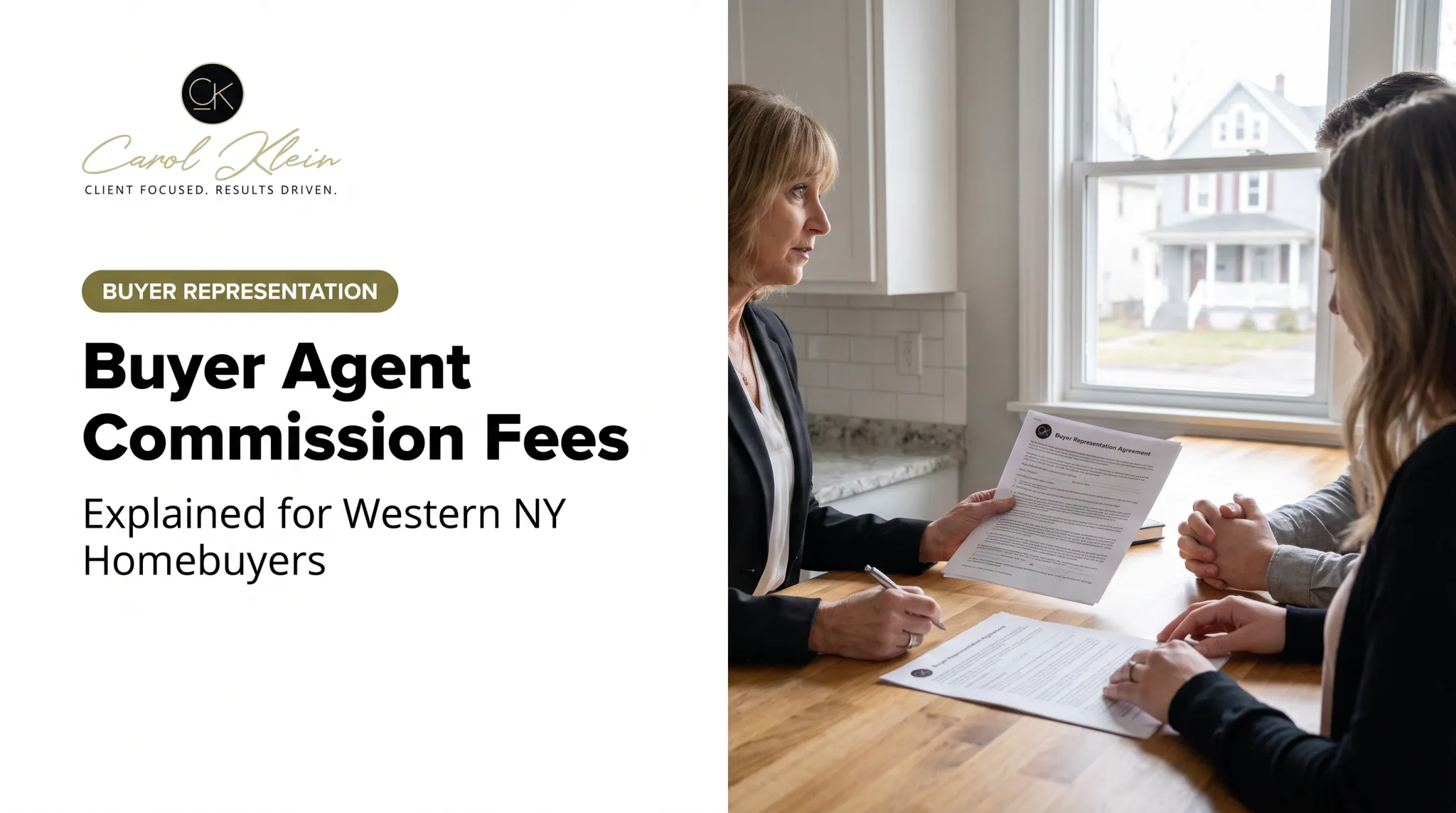
For decades, sellers covered both sides of the commission out of their sale proceeds. That assumption shifted in August 2024, when new industry practices tied buyer-agent compensation to written agreements negotiated upfront, rather than something automatically built into every deal through the MLS.
Many buyers and sellers now ask the same questions: Who actually pays my agent? Can I negotiate the fee? What happens if the other side won't cover it?
This guide covers traditional commission practices, what changed and why, how commission gets calculated and paid, your negotiation options, and what Western New York buyers and sellers should confirm before signing anything.
Key Takeaways
- Buyers may now owe their own agent under a written agreement, ending the old default of sellers covering both sides.
- Commission rates and who pays them are negotiable; document terms before work begins or closing.
- Seller concessions toward a buyer's agent fee are still allowed, but no longer automatic.
- Separate agent pay from other closing costs and review the final settlement statement carefully.
Who Pays Real Estate Agent Commission Today?
The short answer: whoever agrees to pay under a written listing agreement, buyer-broker agreement, concession, or purchase contract is responsible for that fee. No law or MLS rule assigns commission automatically to either side.
Three Common Payment Arrangements
- Seller pays the listing agent and may separately offer compensation toward the buyer's agent as part of the deal.
- Buyer pays the buyer's agent directly, according to the terms spelled out in their buyer-broker agreement.
- Buyer and seller share the cost through negotiated concessions or adjustments written into the purchase contract.
Under the traditional model, sellers agreed to one total commission, and the listing brokerage split part of it with the buyer's brokerage. That arrangement still happens today. It's just no longer assumed by default.
Who Sends the Check vs. Who Bears the Cost
It helps to separate two things: who writes the check at closing, and who actually bears the economic cost.
A seller might send the buyer-agent fee from sale proceeds, but that money often comes from the price the buyer agreed to pay, or from cash the buyer would have otherwise kept. A seller is not automatically required to pay a buyer's agent just because the buyer brought representation to the table.
Example: Say a buyer's agreement calls for a $9,000 fee.
- The buyer could pay that amount directly out of pocket.
- The seller could offer a concession the buyer applies toward the fee.
- The seller could agree, through negotiation, to pay the buyer's agent directly as part of the offer.
Same fee, three different paths to get there. Which one happens depends entirely on what's negotiated and written down before the transaction closes.
Katie Slaiman, a REALTOR® with the Carol Klein team, recently helped a first-time buyer negotiate the concessions needed to make an offer work in a competitive seller's market. Creative structuring doesn't change who officially owes the fee. It only changes how the fee gets covered.
What Changed After the 2024 NAR Settlement?
In August 2024, the National Association of REALTORS® implemented practice changes that reshaped how buyer-agent compensation gets discussed and disclosed. These changes didn't create one federal commission rule, and they don't force every transaction into an identical process. The changes followed industry-wide litigation over broker compensation practices, but for everyday buyers and sellers, the practical effect is more paperwork upfront, not a mandated price cut.
Written Buyer Agreements Are Now Required
Before an agent can tour homes with a buyer in person or virtually, MLS participants must have a signed buyer-broker agreement, according to NAR's 2024 announcement. That agreement should spell out:
- Services the agent will provide
- The fee amount or how it's calculated
- How long the agreement lasts
- Who is responsible for payment
Compensation Moved Off the MLS
Offers of buyer-agent compensation can no longer appear on the MLS. Sellers can still negotiate compensation or offer concessions. Those conversations just happen outside the MLS listing itself. This is a change in where the offer gets communicated, not a ban on sellers paying buyer-agent fees.
Buyers should ask their agent how the fee will be paid before touring homes or writing an offer, not after. Sellers should talk with their listing agent about whether offering buyer-agent compensation, or a concession, could affect how many buyers make offers and what net proceeds look like.
Brokerage policies, lender requirements, and state law can all affect how these rules play out locally. Confirm the details with your agent, attorney, or another qualified professional before signing anything.
How Real Estate Commission Is Calculated and Paid
Commission is typically calculated as a percentage of the sale price, though flat fees and tiered structures exist too. The basic formula: sale price × agreed rate = total commission.
Example: On a hypothetical $350,000 sale with a hypothetical 5% total agreed commission, the math looks like this: $350,000 × 0.05 = $17,500. This is purely an illustration, not a standard or required rate.
Bankrate's 2026 survey found average combined commission rates around 5.7%, split roughly between listing-side and buyer-side agents. Rates vary by market, property, and negotiation, so treat any average as a reference point, not a target.

How the Total Fee Gets Divided
A total negotiated fee is often divided among:
- The listing brokerage
- The listing agent
- The buyer's brokerage
- The buyer's agent
These internal agent-broker splits aren't part of the client's commission rate. They're how brokerages pay their agents after the client's fee is collected.
When and Where Commission Gets Paid
Commission is typically paid at closing. A title company, escrow agent, or closing attorney usually processes the payment, depending on your state and transaction type.
Commission Isn't the Only Closing Cost
Don't confuse agent commission with other line items at closing:
- Lender and loan origination charges
- Title insurance and search fees
- Recording fees and transfer taxes
- Prepaid property taxes and homeowners insurance
- Attorney fees (common in New York transactions)
Commission is usually one of the largest line items, but it's far from the only one. Reviewing your closing disclosure line by line shows exactly what you're paying for, and to whom.
How Commission Costs Affect Buyers and Sellers
For Buyers
An unpaid buyer-agent fee affects more than your agent's paycheck; it affects your cash to close. If your buyer-broker agreement sets a fee and nobody else covers it, you need to budget for it directly or negotiate for help.
Before you tour homes, ask:
- Can a seller concession be applied toward my agent's fee?
- Does my lender allow this specific fee structure under my loan terms?
- What happens to my offer strategy if the seller won't contribute?
The Carol Klein team's buyer representation service includes negotiating to have the seller cover some or all of these fees whenever the terms allow it, so buyers aren't caught off guard at the closing table.
For Sellers
Listing-side compensation and any agreed buyer-agent payment come out of your net proceeds after mortgage payoff and other transaction costs. Weigh these costs as part of your overall pricing and marketing strategy, not in isolation.
Before signing a listing agreement, compare:
- Total fee and what services it includes
- Listing term and cancellation provisions
- Estimated net proceeds after all costs

One seller, Bradley K., credited his agent's full marketing plan, not just a lower fee, for the above-asking offer he received. A smaller headline number doesn't always produce a bigger number in your pocket.
Can Real Estate Agent Fees Be Negotiated?
Commission and other fee structures are generally negotiable, but whatever you agree to must be documented clearly and stay consistent with your state's law and your brokerage's policies.
What's Negotiable
- Percentage rate or flat fee amount
- Scope of services and marketing package
- Listing term or buyer-agreement length
- Payment timing and conditions
Full-Service vs. Discount Options
Full-service representation, discount brokerages, flat-fee listings, and FSBO (for sale by owner) all shift different amounts of work, risk, and negotiation responsibility onto you. Discount brokerages often charge less upfront. Common trade-offs include:

- Fewer showings
- Limited paperwork support
- Less hands-on negotiation when multiple offers come in
Weigh those trade-offs against the fee itself, not just the sticker number.
Sellers should compare estimated net proceeds and service deliverables, not just the headline percentage. Buyers should compare representation scope and total cash-to-close, not just the quoted fee.
A licensed, client-focused Western New York team like Carol Klein - Century 21 Northeast can walk buyers and sellers through valuation, marketing, negotiation, and written fee arrangements before anyone commits.
Choosing an Agent and Reviewing the Agreement
Questions to Ask Before You Sign
- What services are included in this agreement?
- How is compensation calculated: percentage, flat fee, or something else?
- Who pays each component of the fee?
- When is payment due?
- What happens if the transaction doesn't close?
What to Review in the Agreement
Buyers should check their buyer-broker agreement for:
- Exclusivity terms and duration
- Termination conditions
- Any protection period that could make a fee due even after the agreement ends
Sellers should review their listing agreement for the same issues, plus any additional charges beyond commission.
A Note for New York Buyers and Sellers
New York doesn't set one universal real estate fee that applies to every deal. New York's consumer guide confirms commission rates are negotiable statewide, with no mandatory rate. Confirm current requirements and local practices with a licensed professional before signing.
Carol Klein - Century 21 Northeast supports buyers and sellers across East Aurora, Orchard Park, Amherst, Buffalo, and other Western New York communities. The team walks through market-informed valuations, marketing plans, and negotiation support before you commit to anything in writing.
Before closing, ask for a written estimate of your net proceeds (sellers) or cash-to-close (buyers), then compare it against your final settlement statement.
Bottom Line: Confirm Who Pays Before You Sign
Who pays your agent's commission depends on what you and the other party put in writing, not on some automatically mandated national rate. That's true whether you're buying your first home in Depew or selling a long-time family property in Orchard Park.
Before you sign anything:
- Ask who pays, directly, in plain language.
- Review exactly how the fee is calculated.
- Understand any concessions on the table.
- Confirm what shows up on your closing documents.
- Get professional or legal advice if your situation feels unusual.
If you're buying or selling anywhere in Western New York, a conversation with a licensed real estate professional about your specific goals and expected costs is a good next step before you sign a single form.
Frequently Asked Questions
Why does the seller pay the buyer agent commission?
Sellers traditionally paid both commissions out of sale proceeds to attract more buyers and simplify closing math. Sellers can still offer compensation or concessions toward a buyer's agent fee, but it's negotiated case by case, not automatic.
Do buyers need to pay agent fees?
Buyers may owe their agent under a signed buyer-broker agreement, unless the seller or another negotiated arrangement covers some or all of that fee. Always check the agreement before touring homes.
Who pays realtor fees in New York?
Payment depends on the written agreements and negotiated terms in your specific New York transaction. Confirm current state and local requirements with a licensed real estate professional before signing anything.
How much does a realtor make off of a $300,000 house?
Using a hypothetical 5% combined commission, a $300,000 sale generates $15,000 total, split between both sides' brokerages. Actual earnings depend on the negotiated fee, the broker split, and whether the agent represents the buyer or seller.
Do I have to pay real estate agent fees if I pull out of a sale?
That depends on your listing or buyer-broker agreement, including termination terms, any protection period, and whether your agent already earned the fee under the contract. Review your agreement and ask a professional before walking away.
What is a buyer's agent supposed to do?
A buyer's agent helps with home search, property evaluations, offer strategy, negotiation, and transaction coordination. They should also walk you through your representation fee and contractual obligations before you tour homes.