Many buyers struggle to even know where to start. Should you prioritize a short commute, a bigger yard, a walkable Main Street, or a specific school district? Buffalo city homes sold for a median of $230,000 in the three months ending August 2026, up 2.2% year over year, according to Redfin's 2026 report. That's a different number from what you'll find in Williamsville or Orchard Park, and the gap matters.
This guide compares Buffalo's city neighborhoods and surrounding Western New York suburbs by lifestyle fit, not by crowning one "best" location. Prices and inventory shift fast, so verify current figures before you make an offer.
Key Takeaways
- Elmwood Village, Allentown, Parkside, and North Buffalo suit buyers seeking walkability, culture, and historic homes.
- Williamsville, Amherst, Orchard Park, East Aurora, Lancaster, Cheektowaga, and Depew offer more space and varied prices.
- Commute, lot size, school boundaries, and ownership costs matter more than reputation alone.
- Compare listings, property taxes, insurance, and market conditions before committing to an area.
Overview of Buffalo Neighborhoods and Suburbs
"Buffalo area" searches often blur two different things: the city of Buffalo itself, and the dozens of towns and villages surrounding it. Erie County officially separates these.
Amherst is a town, and Williamsville sits inside it as its own village. The same pattern repeats with Aurora (town) and East Aurora (village), or Lancaster (town) with its own Village of Lancaster center. That distinction matters for taxes, schools, and zoning, not just geography.
Housing stock varies just as widely:
- Historic city homes, including Victorians, foursquares, and bungalows, often built between 1880 and 1930
- Apartments and condos, concentrated downtown and in Elmwood Village
- Older suburban housing in inner-ring towns like Cheektowaga and Depew
- Newer construction in parts of Amherst, Orchard Park, and Lancaster
- Larger-lot properties toward village edges in East Aurora
- Village-center homes with sidewalks and walkable Main Streets
Buffalo city's median sale price was $230,000 in August 2026. Zoom out to the full Buffalo Niagara REALTOR board area, which blends city and suburban sales, and the median climbs to $305,000, with 2,165 homes on the market, up nearly 20% year over year, per BNAR's July 2026 report.

These measure two different footprints, so don't treat them interchangeably.
The communities below are grouped around common buyer priorities: urban amenities, affordability, suburban convenience, outdoor space, village character, and access to major roads and employment centers.
Best Neighborhoods and Suburbs in Buffalo
These areas were chosen for housing variety, community character, amenity access, commute considerations, and relative affordability, not for an objective safety or quality ranking. Treat this as a practical shortlist to narrow your search, not a scorecard.
A young professional wanting nightlife has different needs than a family chasing a specific school district, so weigh each fit against your own situation.
Elmwood Village
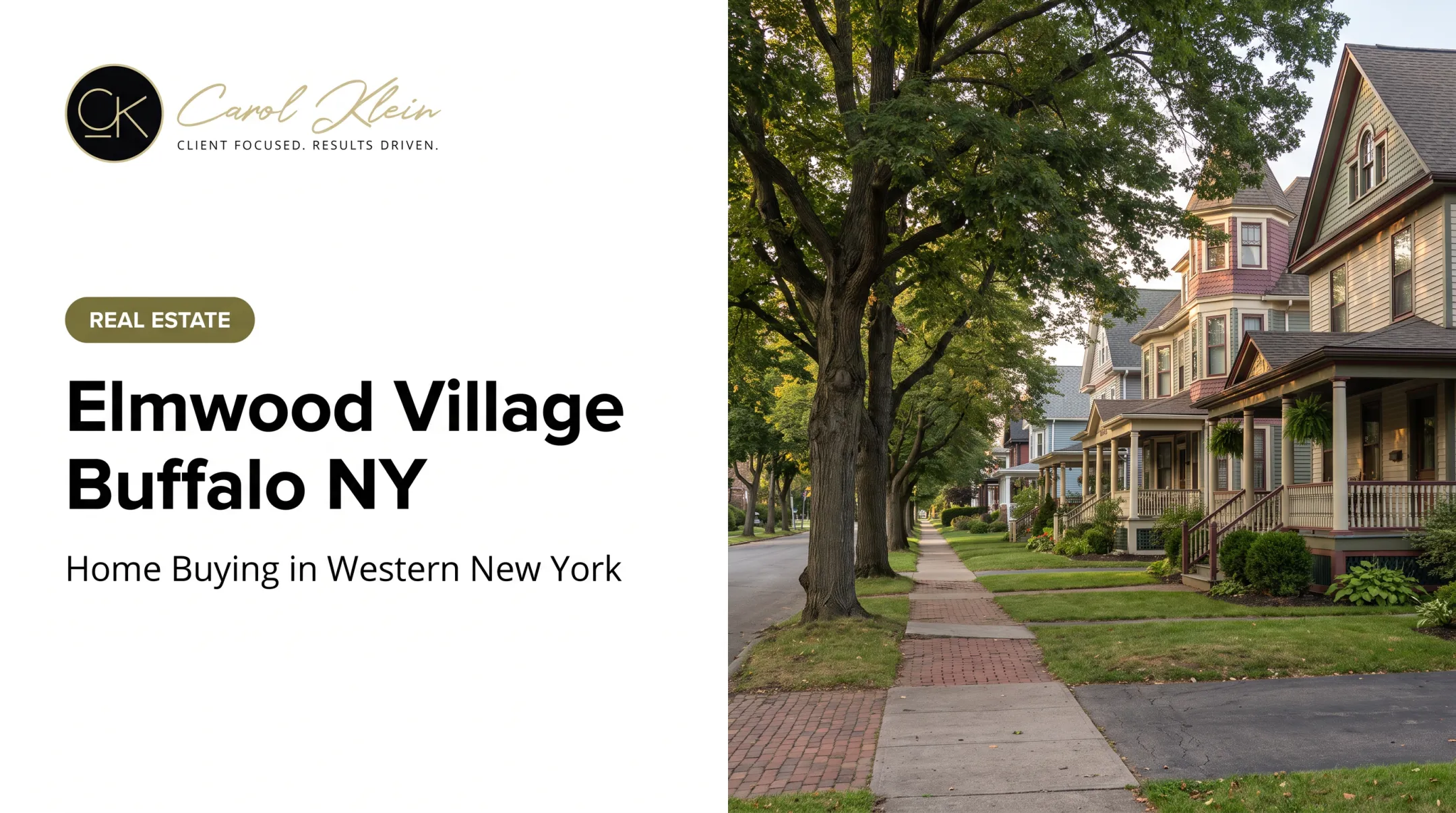
Elmwood Village is Buffalo's classic walkable neighborhood: independent shops, coffee bars, restaurants, and steady foot traffic along Elmwood Avenue. Historic single-family homes and converted multi-unit buildings sit a short walk from Buffalo State and Delaware Park's green space.
This area suits buyers who want:
- An active streetscape over a quiet cul-de-sac
- Character homes rather than large lots
- Walking or biking access to cafés, boutiques, and events
- Proximity to downtown and the medical campus for work
Housing snapshot: Elmwood Village's median sale price was $437,000 in the three months ending August 2026, down 4.4% year over year. One well-known corner near Elmwood and St. James Place scores 91 out of 100 on Walk Score, though walkability varies block to block. Expect condos and apartment rentals alongside single-family and duplex listings, and check current inventory closely since availability shifts fast here.
Allentown, Downtown, and the West Side
These three areas sit close together but serve very different buyers.
Allentown is Buffalo's arts and nightlife district, full of Victorian-era houses, galleries, bars, and a packed events calendar. Expect street parking competition and older building stock that may need updating. Allentown's median sale price was $437,000 in the three months ending August 2026, down 20.5% year over year, reflecting a smaller, more volatile sample of sales.
Downtown Buffalo means condos, lofts, and residential conversions near Canalside, the theater district, and the office core. Across property types, the median sale price ran closer to $555,000 as of an April 2026 snapshot, up 6.7% year over year, though that figure blends condos with larger properties.
The West Side offers a more affordable entry point and a culturally diverse residential fabric, with renovation activity alongside longstanding family blocks. Its median sale price was $270,000 in the three months ending August 2026, down 3.6% year over year.
Who fits where:
- Allentown: renters and buyers who prioritize nightlife and historic character
- Downtown: professionals wanting low-maintenance condo living near work
- West Side: buyers seeking relative affordability and a residential pace
Tour at different times of day. Weeknight noise and weekend parking look very different from a daytime showing.
Parkside and North Buffalo
Parkside sits beside Delaware Park, with homes built mostly between 1880 and 1930: Victorians, Colonial Revivals, American Foursquares, and Craftsman bungalows. It's a favorite for buyers who want historic character and green space without leaving the city. Parkside's median sale price was $462,000 in the three months ending August 2026, down 4.6% year over year.
North Buffalo covers more ground, but the North Park pocket, anchored by Hertel Avenue's restaurants and shops, posted a $390,000 median, up 5.8% year over year for the same period. That number describes North Park specifically; pricing and housing age vary by block across the wider North Buffalo area.
Before you commit to either, ask about:
- Roof, wiring, and plumbing age: homes built before 1930 often need updated systems
- Off-street parking: many blocks rely on street parking only
- Property taxes: city assessments can shift year to year
- Renovation scope: budget for unexpected costs in century-old houses
Williamsville and Amherst
Amherst is the town; Williamsville is a village inside it, a distinction that matters because school district lines don't always follow those boundaries. Williamsville Central School District, for example, also reaches into parts of Clarence and Cheektowaga, so a Williamsville mailing address doesn't guarantee Williamsville schools.
Both areas appeal to buyers who want:
- Suburban convenience, with shopping plazas and medical offices nearby
- A mix of housing ages, from mid-century ranches to newer subdivisions
- Shorter commutes to UB's North Campus and Buffalo employers
Williamsville's village center offers more walkability, sidewalks, and a historic Main Street stretch, while broader Amherst trades that walkability for bigger yards and newer construction in some pockets. Williamsville's median sale price was $430,000 in the three months ending August 2026, up 11.7% year over year. Local buyer's agents, including Carol Klein's team, regularly work with first-time buyers and relocating families across both areas.
Buyer fit:
- Families should verify the exact school attendance zone before falling for a house
- Move-up buyers should look at newer Amherst subdivisions for more square footage
- Relocating professionals may prefer Williamsville's walkable village core
Orchard Park and East Aurora
Orchard Park is a Southtowns staple known for larger homes, mature parks, and an easier commute into Buffalo than some outlying towns. It also has a village center with its own shops, separate from the broader town. Orchard Park's median sale price reached $541,000 in the three months ending August 2026, up 13.0% year over year, a sign of strong demand in a market tight on inventory.
East Aurora trades suburban sprawl for a genuine village feel. Its historic Main Street includes independent shops, restaurants, and the Roycroft Campus, a National Historic Landmark tied to the American Arts and Crafts movement. Knox Farm State Park sits nearby for hiking and open space, and the drive into Buffalo runs about 20 to 25 minutes.
East Aurora's housing market moves quickly. In-village listings near Main Street and Roycroft often draw multiple offers within days, while larger-lot homes toward Girdle Road and the village edges offer more negotiating room. Local data put the median list price near $499,000 for the 14052 ZIP code as of mid-2026, with inventory staying thin, often just a dozen active listings at a time.
Commute patterns echo that trade-off: Orchard Park residents reported a 21.5-minute average commute, versus 23.7 minutes for the broader Aurora town, according to Census Bureau data. Neither figure reflects a drive specifically to downtown Buffalo, so treat them as general benchmarks rather than exact predictions.
Who fits where:
- Move-up families often prefer Orchard Park's larger lots
- Downsizers wanting walkable amenities tend to choose East Aurora's village core
- Buyers wanting a distinctive small-town identity usually pick East Aurora over a standard suburb
Lancaster, Cheektowaga, and Depew
These inner-ring communities sit closer to Buffalo than the Southtowns suburbs, with established housing stock and strong highway access.
Lancaster splits into the town and the separately incorporated Village of Lancaster, with residential pockets like Heritage Hills, Windsor Ridge South, and Hidden Pines. Lancaster's median sale price was $270,000 as of an April 2026 snapshot, up 1.3% year over year, with average asking rents around $1,700 by October 2026.
Cheektowaga is a town bordering Buffalo Niagara International Airport, offering easy highway access and a mix of schools, parks, and shopping. Its median sale price reached roughly $254,861 in the three months ending June 2026, up 6.2% year over year.
Depew, a village within Cheektowaga and Lancaster's borders, combines affordability with proximity to major routes like Transit Road and Broadway. Depew's median sale price sat around $285,000 as of mid-2026, with average asking rents near $1,750.
| Community | Type | Approx. median sale price | Notable access |
|---|---|---|---|
| Lancaster | Town + Village | ~$270,000 | Village center, residential subdivisions |
| Cheektowaga | Town | ~$255,000 | Airport, I-90/I-290 |
| Depew | Village | ~$285,000 | Transit Road, Amtrak station |

Who fits where:
- First-time buyers often find the most accessible entry prices in Depew and Cheektowaga
- Starter-home seekers should check established neighborhoods across all three
- Move-up buyers may prefer Lancaster's newer subdivisions
- Buyers wanting Buffalo access without city living fit any of the three
How We Chose the Best Areas
"Best" is personal. A walkable urban block that excites one buyer feels chaotic to another who wants a quiet cul-de-sac. Use this framework to compare areas against your own priorities:
- Total housing budget: not just the listing price, but the full monthly payment
- Housing type and size: condo, single-family, multifamily, or land
- Commute: to your actual workplace, not a generic downtown estimate
- Walkability and lifestyle: daily errands on foot versus by car
- Parks, schools, and amenities: matched to your household's needs
- Long-term plans: buying for five years or twenty changes the math
Look past the sticker price. A full mortgage estimate factors in property taxes, homeowners insurance, HOA fees, and optional PMI alongside your loan terms, so you see a realistic monthly number before touring a single house.
Before you fall for a neighborhood's reputation, verify directly:
- School district boundaries, through the district's own street directory
- Public safety data, through state or FBI crime reporting tools
- Flood zone status, through FEMA's map service
- Zoning and permitted uses, through the municipal zoning map
Tour prospective blocks at different times of day and different seasons. A street that feels perfect on a sunny Saturday afternoon can feel very different on a dark Tuesday in February.
A local REALTOR® can pull current listings, recent comparable sales, and neighborhood-level market data so you're comparing real numbers, not assumptions.
Conclusion
Buffalo's biggest advantage for home shoppers is the range of lifestyles on offer, from Elmwood Village's walkable streets to East Aurora's village charm to Orchard Park's larger lots.
Start narrowing your search with a few practical steps:
- List your non-negotiables: commute limits, must-have square footage, school boundaries, or a walkable Main Street
- Set a total housing budget that includes taxes and insurance, not just the mortgage
- Visit several communities in person before you commit
Carol Klein - Century 21 Northeast works with buyers and sellers across Buffalo and Western New York, from East Aurora and Orchard Park to Amherst, Lancaster, and Depew. If you want personalized guidance, current listings, a home valuation, or help weighing trade-offs between neighborhoods, reach out to start the conversation.
Frequently Asked Questions
What are the suburbs of Buffalo, NY?
Amherst, Williamsville, Clarence, Orchard Park, East Aurora, Lancaster, Cheektowaga, Depew, West Seneca, Hamburg, and Tonawanda are all commonly grouped under "Buffalo suburbs." Boundaries vary, since some are towns and others are villages inside those towns.
What is the nicest suburb of Buffalo, NY?
It depends on what you value. East Aurora offers village charm and walkability, Orchard Park offers larger lots and parks, and Williamsville offers shopping and shorter commutes. There's no single universal winner.
What are the safest suburbs in Buffalo, NY?
New York's crime data is reported by county and law enforcement agency, not neighborhood by neighborhood, so a ranked "safest suburbs" list isn't well supported. Check current state or FBI crime data for your specific municipality.
What are some safe neighborhoods to live in Buffalo, NY?
Elmwood Village, Parkside, and North Buffalo come up often in buyer searches, but conditions vary block by block. Evaluate the exact street, lighting, traffic, and recent local data rather than a general reputation.
What are the best neighborhoods in Buffalo, NY?
Elmwood Village suits buyers who want walkability and amenities, Allentown fits arts and nightlife lovers, and Parkside and North Buffalo work well for residential city living near parks. The right pick depends on your budget and lifestyle.
What is the best area to stay in Buffalo, NY?
Visitors usually prefer Downtown, Canalside, Elmwood Village, or Allentown for proximity to attractions and dining. Homebuyers planning to live here long-term should look more broadly, including suburbs like Orchard Park or Williamsville.