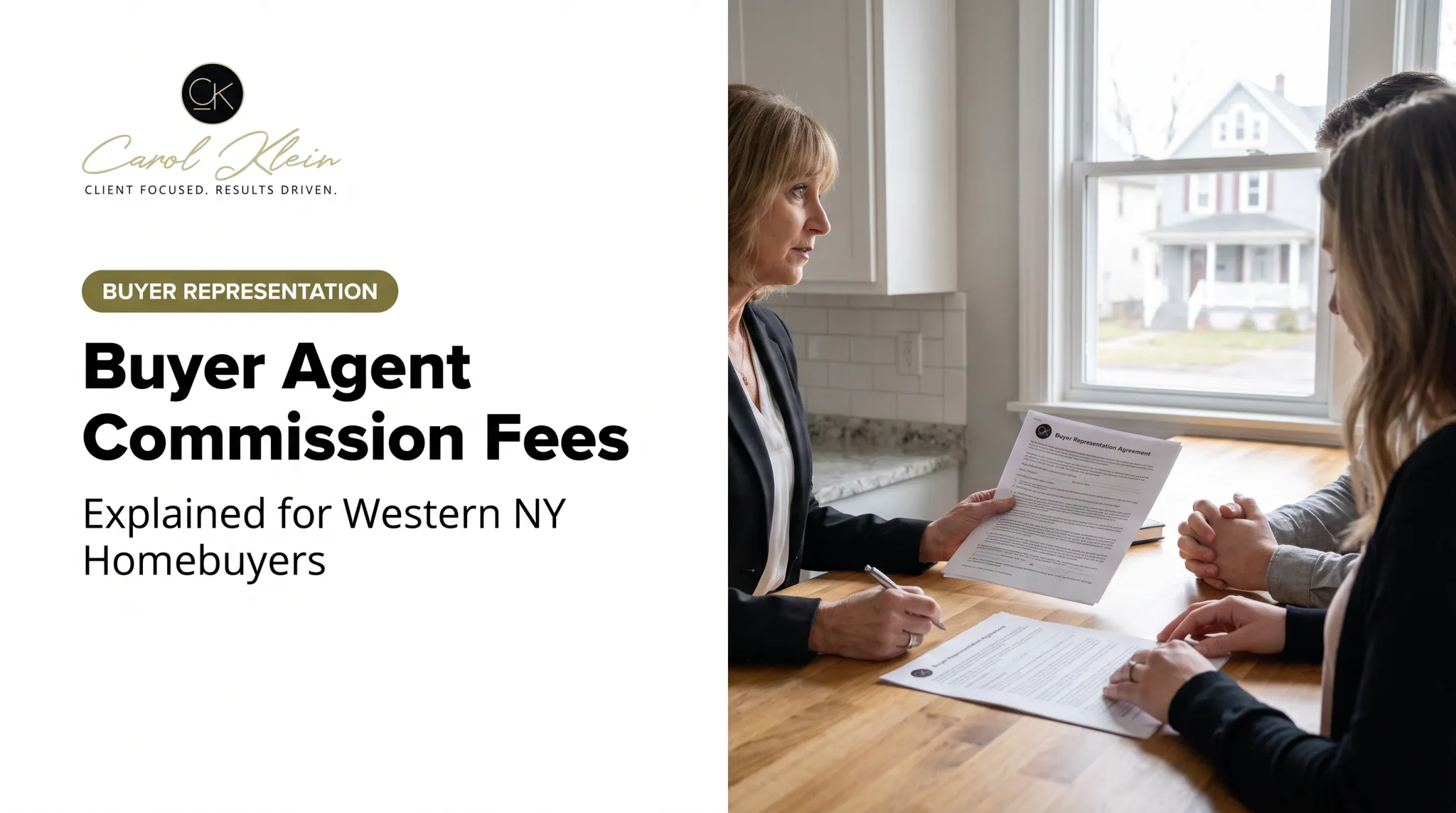
A buyer's agent agreement is simply a written contract that spells out the relationship between you and your real estate professional: what services they'll provide, how and when they get paid, how long the arrangement lasts, and how either side can end it.
Signing one doesn't commit you to buying a home, but the terms inside it can still carry real weight. This guide walks through what to review before signing, what's negotiable, how compensation actually works, and why state law makes a genuine difference. Carol Klein's team fields these questions from Western New York buyers regularly, so let's work through them one at a time.
Key Takeaways
- A signed buyer's agent agreement can be legally enforceable, not just a formality
- Review the term, compensation, exclusivity, agent duties, termination process, and any carryover period before signing
- Compensation is negotiable; never assume a seller contribution will cover the full amount
- State laws and brokerage practices vary widely, so ask questions and consult an attorney when language is unclear
- Working with multiple agents under separate agreements can create conflicting obligations
What Is a Buyer's Agent Agreement and How Does It Work?
You might hear this document called a few different things:
- Buyer agency agreement
- Buyer representation agreement
- Buyer-broker agreement
They all describe the same thing: a contract between you and an agent, or their brokerage, defining the working relationship.
Agreement vs. Purchase Contract
Don't confuse this with the purchase contract you'll sign later. The buyer's agent agreement governs your relationship with the agent. The purchase contract governs the terms of buying a specific house: price, contingencies, closing date. They're separate documents, often signed weeks or months apart.
How the Relationship Typically Unfolds
A buyer-agent relationship usually moves through a few phases:
- Interview the agent and define what you're searching for
- Sign the agreement before touring homes
- Tour properties and narrow the search
- Prepare and submit offers
- Negotiate terms with the seller
- Complete inspections and other due diligence
- Close on the property
The Klein Team's own buyer's guide follows a similar path. It starts with a wants-and-needs assessment and mortgage pre-approval, then moves into private showings and open houses. Offer preparation and negotiation come next, with a transaction coordinator managing inspections through closing day.

Why Agents Ask for a Signature First
Following the real estate industry's 2024 commission-litigation settlement, many agents affiliated with MLS participants now need a signed written agreement before touring a home with a buyer. That covers in-person tours and live virtual tours, according to NAR's consumer guide.
Simply visiting an open house on your own, or asking an agent general questions about their services, doesn't trigger this requirement.
Signing does not give your agent authority to make decisions for you. It defines:
- What the agent will do for you
- What you'll owe them, and when
- How long you're working together
- How either party can walk away
What Are the Common Elements of a Buyer Representation Agreement?
Every buyer representation agreement covers the same core ground, even though exact wording varies by brokerage and state.
Term and Geographic Scope
Look for the start and end dates, any renewal language, and whether the agreement applies to one property, a defined search area, or any qualifying purchase during the term. Scope examples can run as short as one day or as narrow as one ZIP code; there's no standard duration.
Agent Duties
A typical agreement outlines what your agent will actually do:
- Identify suitable properties
- Arrange and accompany showings
- Prepare and present offers
- Negotiate price and terms
- Communicate deadlines and contingencies
- Coordinate with lenders, inspectors, and attorneys
- Explain your options, without deciding for you
Explain, not decide. The agent advises. You choose.
Compensation Language
This section should spell out the exact dollar amount, percentage, or hourly rate, how it's calculated, when payment is due, and whether you could owe the agent directly under certain circumstances. Vague wording here is the single biggest red flag in the entire document.
Exclusivity and Protection Periods
Check whether you're free to work with another agent, what happens if you find a property on your own, and whether a protection or carryover period applies after the agreement ends. That clause could mean you still owe compensation if you buy a home the agent showed you, even after the agreement expires.
Termination and Dispute Terms
Look for notice requirements, cancellation fees, mutual release language, what counts as breach, and any mediation or arbitration requirement. Get exit terms confirmed in writing; a verbal "sure, no problem" doesn't override contract language.
Before you sign, ask what every unfamiliar term means. If the brokerage can't explain a clause in plain English, pause there. A real estate attorney can review wording you're unsure about.
How Does Compensation for a Buyer's Agent Work?
There's no universal commission rate for buyer's agents. Compensation is negotiated between you and your agent and should be written in exact, calculable terms rather than left open-ended, per NAR's buyer agreement guide.
Common Compensation Structures
- Percentage of purchase price: a set rate, agreed upfront
- Flat fee: a fixed dollar amount regardless of sale price
- Hourly fee: less common, typically for limited-scope arrangements
- Another clearly defined structure: whatever you and your agent agree to in writing
Who Might Help Cover the Cost
A seller, or the seller's agent, may agree to contribute toward your agent's compensation as part of the deal. This can show up as a direct seller concession, a portion of the listing broker's compensation, or a negotiated credit built into the offer. Never assume this contribution exists or covers your full obligation. It's property-specific and offer-specific, not a given.
Here's the part buyers often miss: if your agreement specifies a set amount, say $12,000, and the seller only agrees to contribute $8,000, you may be responsible for the $4,000 difference depending on your contract's wording. The agreed fee and the seller's contribution are two separate numbers that don't automatically match.

Questions to Ask Before You Sign
- Do I owe compensation if I buy a home my agent didn't show me?
- What if I end up working with a different agent?
- What happens if I stop my search altogether?
- Am I responsible for a fee if I cancel before the agreement expires?
Once you're under contract, compare the compensation clause in your buyer's agreement against the purchase offer and your settlement disclosures. The numbers should match. If they don't, ask why before closing day, not after.
What Types of Buyer's Agreements and Representation Arrangements Exist?
Exclusive vs. Nonexclusive Agreements
- Exclusive buyer agency: You work with one agent or brokerage for a set period—the most common full-service setup
- Nonexclusive agreement: You may work with multiple agents under set conditions; pay usually goes to the agent who found or showed the home
Working with multiple agents is technically legal in certain situations, but a signed agreement can still create conflicting obligations if the overlap isn't handled carefully.
Limited-Scope Agreements
Some brokerages offer narrower arrangements. Availability depends on the agent and firm; not every office provides them.
Common limited-scope options include:
- A single showing
- One specific property
- A short trial period
- A narrowly defined service package
The Tradeoff With Exclusivity
An exclusive relationship usually means more continuity. Your agent already knows your search history, must-haves, and deal-breakers. The tradeoff is understanding your obligations if your plans change or another agent enters the picture.
Dual Agency and Disclosed Representation
In some states, one agent or brokerage may represent both buyer and seller in the same transaction, or hold relationships with both parties. Rules vary significantly. New York's agency law allows dual and designated agency with both parties' informed written consent. Other states ban it outright.

Don't assume your state's rules, and don't assume your consent is automatic. Read disclosure language closely and ask your agent exactly who they represent in your transaction.
How Should You Review and Negotiate the Agreement Before Signing?
Before signing anything, run through this list with your agent:
- What services are included, specifically?
- How long does the agreement last?
- Is it exclusive, or can I work with other agents?
- What exactly could I owe, and under what circumstances?
- What happens if I find a property myself?
- How do I cancel, and is there a fee?
- Is there a carryover period after the agreement ends?
- What conflicts or dual-agency disclosures apply?
What's Usually Negotiable
- A shorter initial term, such as 30 to 60 days instead of six months
- Clearly defined services rather than vague catch-all language
- A precise compensation formula, not a range
- A reasonable, low-cost termination process
- Written confirmation of any verbal changes
Red Flags Worth Pausing On
- Blank or open-ended compensation fields
- "Any transaction" language with no limits
- Automatic renewal clauses
- Unclear obligations after the agreement expires
- Broad cancellation penalties
- Dual-agency provisions that aren't clearly disclosed
Interview more than one agent before committing. Look for someone who answers your questions directly, understands your priorities, and explains the agreement without rushing you to sign.
If you're searching for a home anywhere from Buffalo to East Aurora, Orchard Park, or Amherst, Carol Klein's team at Century 21 Northeast can walk you through buyer representation, local search strategy, and negotiation support. They'll review agreement terms with you before anything is signed. Reach the team at (716) 671-3344.
Real estate law differs by state, and brokerage practices differ even more. Confirm current requirements where you're buying, and talk to a qualified real estate attorney if any contract language is unclear or disputed.
Frequently Asked Questions
Why does the seller pay the buyer's agent?
A seller may agree to contribute toward the buyer agent's compensation as part of a purchase offer, but the arrangement is negotiable, not automatic. Your signed buyer's agent agreement may still determine what you personally owe.
What is a buyer's agent contract?
It's a written agreement between you and your agent that sets out services, compensation, duration, exclusivity, and how either party can end the relationship.
What are the common elements of a buyer representation agreement?
Term length, agent duties, compensation structure, property or geographic scope, exclusivity, termination rights, required disclosures, and any protection period after expiration.
What are the three types of buyer's agreements?
Agreements are generally described as exclusive, nonexclusive, or limited-scope/property-specific. Terminology and availability vary by state and brokerage, so ask your agent which type you're signing.
Are buyer-broker agreements enforceable?
Yes, a signed agreement can be enforceable as a legal contract. Enforceability depends on its exact language and your state's law, so get legal advice for a specific dispute.
Can an agent represent both the buyer and the seller?
In some states, dual agency or designated agency lets one agent or brokerage work with both sides given proper disclosure and consent. Rules vary significantly, so review disclosure forms carefully before signing.